Blog

Bricks calculation Guide by Kailash Bricks

Brick Calculation Guide: How Many Bricks Do You Need for a House?

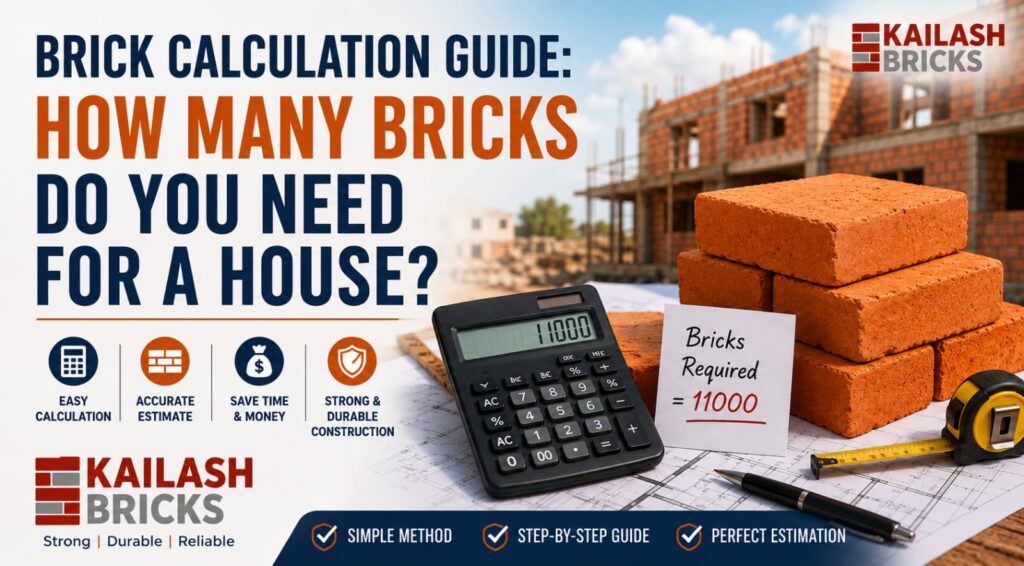
When building a house, one of the most common questions people ask is: “How many bricks will I need? Brick calculation is an important step in construction because it helps estimate the total materials required for building walls. Proper brick calculation not only saves money but also ensures that construction work runs smoothly without delays. If you buy fewer bricks than required, the construction work may stop in the middle. On the other hand, buying too many bricks can increase the overall cost unnecessarily. That is why builders and engineers always calculate the number of bricks before starting construction. Using high-quality materials such as Kailash Bricks also ensures better strength and durability for your building. In this guide, we will learn a simple method to calculate the number of bricks needed for a house. Why Brick Calculation Is Important Before starting any construction project, calculating the number of bricks is essential. It helps builders and homeowners plan materials efficiently. Here are some key benefits of brick calculation: When builders use reliable materials like Kailash Bricks, proper brick estimation becomes even more important because it ensures the right quantity of quality bricks is purchased. Standard Brick Size To calculate bricks correctly, you must first know the size of a standard brick. In many countries, the standard brick size is: 190 mm × 90 mm × 90 mm However, when mortar (cement mixture between bricks) is added, the effective brick size becomes: 200 mm × 100 mm × 100 mm This size is usually used in brick calculations because mortar joints increase the overall dimensions slightly. High-quality bricks like Kailash Bricks are manufactured with proper dimensions, which helps maintain uniformity during construction. Basic Formula for Brick Calculation The most common formula used for brick calculation is: Number of Bricks = Volume of Wall ÷ Volume of One Brick Engineers and builders widely use this formula because it gives a reliable estimate of the required bricks. Let’s understand the process step by step. Step 1: Calculate Wall Volume First, calculate the volume of the wall using this formula: Wall Volume = Length × Height × Thickness Example: Wall length = 10 meters Wall height = 3 meters Wall thickness = 0.2 meters So, Wall Volume = 10 × 3 × 0.2 Wall Volume = 6 cubic meters This means the total volume of the wall is 6 cubic meters. Step 2: Calculate Volume of One Brick Now, calculate the volume of a single brick, including mortar. Brick size with mortar: 0.2 m × 0.1 m × 0.1 m Brick Volume = 0.002 cubic meters Standardised bricks, such as Kailash Bricks, have consistent dimensions, which makes calculations more precise and construction more efficient. Step 3: Calculate the Number of Bricks Now divide the wall volume by the volume of one brick. Number of Bricks = Wall Volume ÷ Brick Volume Number of Bricks = 6 ÷ 0.002 Number of Bricks = 3000 bricks So, approximately 3000 bricks are needed to build this wall. Add Extra Bricks for Wastage During construction, some bricks may break or get damaged. Because of this, builders usually add 5–10% extra bricks to the total estimate. Example: Required bricks = 3000 10% extra = 300 bricks Total bricks needed = 3300 bricks Using strong bricks such as Kailash Bricks can reduce breakage and ensure better durability for the structure. Bricks Required per Square Meter Sometimes builders use a simpler estimation method instead of volume calculations. For example: A 9-inch wall requires about 100–110 bricks per square meter A 4.5-inch wall requires about 50–55 bricks per square meter Example: If the total wall area is 50 square meters, then: Bricks required = 50 × 100 Total bricks = 5000 bricks This method is faster and commonly used at construction sites. Factors That Affect Brick Requirement The number of bricks needed for a house may change depending on several factors. 1. Wall Thickness Thicker walls require more bricks. For example: 9-inch walls require more bricks, 4.5-inch walls require fewer bricks 2. Doors and Windows Doors and windows reduce the number of bricks required because those spaces are empty. For example, if a wall has large windows or multiple doors, the total brick requirement will decrease. 3. Mortar Thickness Mortar joints usually have a thickness of about 10 mm. If the thickness of the mortar joint changes, the total number of bricks required may also change slightly. 4. Brick Quality and Size Brick size and quality also affect construction. Uniform and strong bricks like Kailash Bricks help create better bonding and stronger walls. Example: Bricks Needed for a Small House Let’s take a simple example of a small house. Assume: Total wall area = 100 square meters For a 9-inch wall: Bricks required per square meter ≈ : 100 bricks Total bricks required: 100 × 100 = 10,000 bricks Add 10% extra for wastage: 10,000 + 1,000 = 11,000 bricks So, approximately 11,000 bricks are required to build the walls of a small house using quality materials such as Kailash Bricks. Tips to Estimate Bricks Correctly Here are some helpful tips for accurate brick estimation: ✔️ Measure wall dimensions carefully ✔️ Always add extra bricks for breakage ✔️ Subtract the area of doors and windows ✔️ Use standard brick sizes for calculations ✔️ Choose reliable bricks like Kailash Bricks for better durability These steps help builders calculate materials more accurately and avoid unnecessary costs. Modern Tools for Brick Calculation Today, many online calculators and construction apps help estimate the number of bricks required quickly. You simply need to enter: The calculator automatically provides the number of bricks needed. This makes the process faster and reduces the chances of calculation errors. Brick calculation is an essential step in any construction project. Knowing the number of bricks required helps builders manage materials efficiently, control construction costs, and complete projects without delays. The process is simple: By following these steps and using reliable materials such as Kailash Bricks, you can ensure strong, durable, and well-planned construction. Proper

Brick Calculation Guide: How Many Bricks Do You Need for a House? Read More »

Best Weather Conditions for Brick Construction

How Weather Affects Brick Quality During Construction

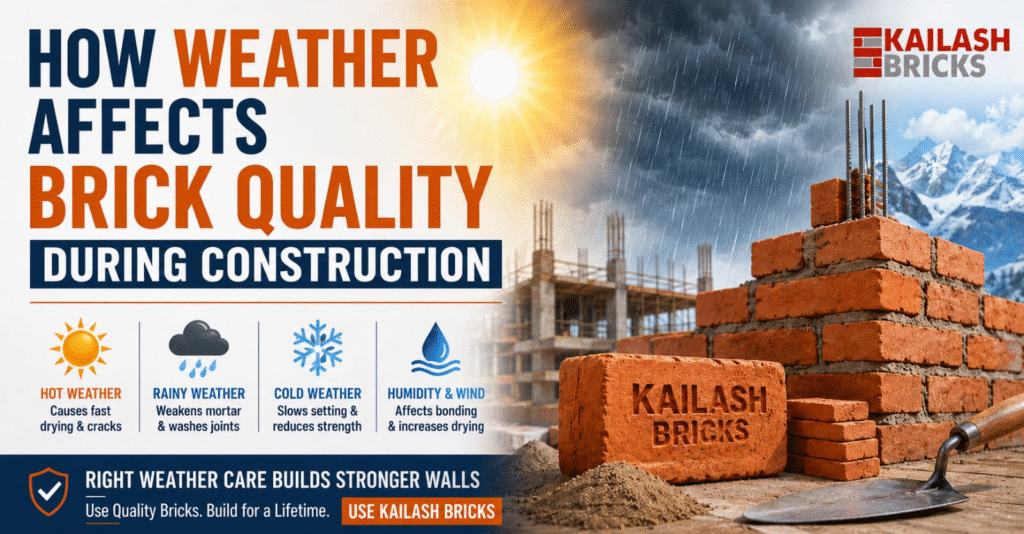
Weather plays a very important role in construction, especially when working with bricks. Many people focus mainly on materials like cement, sand, and bricks, but weather conditions such as temperature, rainfall, humidity, and wind can greatly affect the quality and strength of brickwork. If brick construction is done without considering the weather, it can lead to weak walls, cracks, poor bonding, and long-term structural issues.  That is why builders and engineers always keep an eye on weather conditions before and during construction work. Using high-quality materials such as Kailash Bricks also helps maintain strong and durable construction even in challenging weather conditions. In this article, we will understand how different weather conditions affect brick quality and what precautions builders should take during construction. Why Weather Matters in Brick Construction : Brick construction involves materials such as bricks, cement mortar, and water. These materials interact with each other through a chemical process known as hydration.  This process allows cement mortar to gain strength and bind bricks together. Weather conditions directly influence this process. For example: Because of these factors, weather conditions directly affect the strength, durability, and stability of brick walls. Using strong and reliable materials like Kailash Bricks helps reduce some risks, but weather precautions are still necessary. Effect of Hot Weather on Brick Construction : Hot weather is one of the biggest challenges during brick construction. When temperatures rise significantly, several issues can occur. 1. Fast Drying of Mortar In very hot conditions, water in the cement mortar evaporates quickly. This prevents proper hydration of cement, which means the mortar does not gain its full strength. As a result, the bond between bricks becomes weaker. 2. Cracks in Brick Walls Rapid drying can cause shrinkage in the mortar joints. Over time, this shrinkage may lead to cracks in the brick walls. These cracks can weaken the structure and reduce its durability. 3. Reduced Bond Strength When the mortar dries too fast, it cannot properly adhere to the bricks. This weak bonding can affect the stability of the entire wall. High-quality bricks, such as Kailash Bricks, can improve bond strength, but proper construction practices are still necessary. Prevention in Hot Weather Builders usually take the following precautions during hot weather: These steps help maintain the strength and durability of brick construction. Effect of Rainy Weather on Brick Construction Rain can also create serious problems during brick construction. Although water is required for cement hydration, excessive rainwater can disrupt the construction process. 1. Weak Mortar Mix Heavy rain can dilute the cement mortar mixture. When this happens, the mortar loses its strength and bonding capacity, leading to weak brick joints. 2. Mortar Washing Away If rain falls immediately after brick laying, it may wash away the cement paste from the mortar joints. This reduces the durability and strength of the wall. 3. Uneven Brick Alignment Rain creates slippery conditions, which makes it difficult for workers to place bricks accurately. This may lead to uneven brick alignment and poor wall structure. Even when using quality materials such as Kailash Bricks, protection from rain is necessary for proper construction. Prevention in Rainy Weather Builders usually follow these safety measures: These precautions help maintain the quality of brick construction. Effect of Cold Weather on Brick Construction Cold weather also affects brick construction, especially in regions where temperatures drop significantly. Low temperatures slow down the chemical reactions in cement mortar, which can delay the construction process. 1. Slow Setting of Mortar In cold conditions, mortar takes longer to set and gain strength. This slows down construction progress. 2. Freezing of Water in Mortar If temperatures drop below the freezing point, water inside the mortar may freeze. Frozen water expands and can damage the bond between bricks, leading to cracks and weak joints. 3. Reduced Work Efficiency Cold weather also makes it difficult for construction workers to maintain normal work speed and efficiency. Strong bricks like Kailash Bricks help maintain structural strength, but additional precautions are still required in cold climates. Prevention in Cold Weather Builders use several methods to handle cold weather conditions: These methods help maintain proper bonding between bricks. Effect of Humidity on Brick Quality Humidity refers to the amount of moisture present in the air. Both high humidity and low humidity can affect brick construction. High Humidity High humidity slows down the drying process of mortar. While this may reduce cracking, it can also delay construction progress. Low Humidity Low humidity increases evaporation from mortar, which can weaken bonding between bricks. To reduce these effects, builders often use proper curing techniques and quality materials like Kailash Bricks. Effect of Wind on Brick Construction Wind is another environmental factor that can influence brick quality. Strong winds increase the evaporation rate of water from mortar. This can cause: To prevent this issue, workers may install temporary wind barriers or cover fresh brickwork during construction. Importance of Proper Curing Regardless of weather conditions, curing is essential for strong brick construction. Curing means keeping brick walls moist for several days so that the cement mortar gains full strength. Usually, brick walls should be cured for 7 to 10 days after construction. When high-quality bricks such as Kailash Brick are used along with proper curing, the result is stronger and longer-lasting brickwork. Best Weather Conditions for Brick Construction The ideal weather conditions for brick construction include: These conditions allow mortar to set properly and create strong brick bonds. Weather conditions have a significant impact on brick construction quality. Factors such as heat, rain, cold, humidity, and wind can affect mortar strength, brick bonding, and the overall durability of a structure. By understanding how weather affects construction and taking proper precautions, builders can ensure strong, long-lasting brick walls. Using reliable and durable bricks, such as Kailash Bricks, also helps improve construction quality. In simple terms, successful brick construction depends not only on good materials and skilled labour but also on working with the right weather conditions and proper planning.

How Weather Affects Brick Quality During Construction Read More »

Brick Colour Psychology

Brick Colour Psychology: How Brick Shades Affect Home Aesthetics

When building a home, brick selection is often viewed as a structural decision. However, at Kailash Bricks, we believe bricks do far more than support walls—they shape emotions, influence perception, and define the personality of a home.The colour of bricks plays a powerful psychological role in how a space looks, feels, and even how it’s remembered. In this article, we explore brick colour psychology, how different brick shades affect home aesthetics, and how choosing the right brick can elevate both design and comfort. Why Brick Colour Matters in Home Design Brick colour is one of the most permanent design choices a homeowner makes. Unlike paint or décor, bricks remain visible for decades. The shade, tone, and texture of bricks influence: At Kailash Bricks, we help homeowners and builders choose brick colours that balance aesthetics, durability, and emotional impact. Understanding Brick Colour Psychology Colour psychology studies how colours affect human emotions and behavior. When applied to bricks, it directly impacts how a home feels from the inside and how it is perceived from the outside. Let’s explore popular brick shades and their psychological effects. Red Bricks: Warmth, Strength & Timeless Appeal Psychology:Red bricks evoke warmth, security, and tradition. They are associated with strength, stability, and longevity. Aesthetic Impact: Best For: At Kailash Bricks, our high-quality red bricks remain a favorite for homeowners seeking enduring beauty and emotional warmth. Brown & Earth-Toned Bricks: Comfort and Natural Harmony Psychology:Earthy brick shades create a sense of grounding, reliability, and calm. They connect the home to nature. Aesthetic Impact: Best For: Kailash Bricks’ earth-toned options are ideal for homeowners who want a natural, balanced aesthetic. White & Light-Coloured Bricks: Space, Purity & Modern Elegance Psychology:Light brick colours reflect cleanliness, simplicity, and openness. They promote mental clarity and calmness. Aesthetic Impact: Best For: When paired with precision manufacturing, Kailash Bricks’ lighter shades offer elegance without sacrificing strength. Grey Bricks: Sophistication and Urban Charm Psychology:Grey symbolizes balance, neutrality, and sophistication. It feels modern, calm, and refined. Aesthetic Impact: Best For: Our grey brick variants at Kailash Bricks are engineered for those who prefer modern aesthetics with understated confidence. How Brick Colour Affects Exterior vs Interior Aesthetics Exterior Impact Interior Impact Choosing the right brick shade ensures harmony between the inside and outside of your home. Choosing the Right Brick Colour with Kailash Bricks At Kailash Bricks, we guide customers through brick selection by considering: Our bricks are manufactured with consistent colour quality, superior strength, and long-lasting finish, ensuring your home looks beautiful for generations. Final Thoughts: Build with Colour, Build with Confidence Brick colour is not just a design choice—it’s an emotional and psychological investment. The right shade can transform a house into a welcoming, inspiring home. With decades of experience and a commitment to excellence, Kailash Bricks helps you build not just walls, but lasting impressions and meaningful spaces. Choose wisely. Choose Kailash Bricks.

Brick Colour Psychology: How Brick Shades Affect Home Aesthetics Read More »

compressive strength of a brick explained by Kailash Bricks

Understanding Compressive Strength: What It Means for Your Building

When it comes to constructing safe, durable, and long-lasting buildings, compressive strength is one of the most critical factors to consider. Whether you are building a residential home, a commercial structure, or an industrial project, the quality of construction materials directly affects structural performance. At Kailash Bricks, we believe that understanding compressive strength helps builders, engineers, and homeowners make informed decisions that ensure safety and longevity. What Is Compressive Strength? Compressive strength refers to a material’s ability of withstand loads that tend reduce its size, such as bricks, concrete blocks, or masonry units. In simple terms, it measures how much pressure a building material can handle before it fails or cracks. In construction, compressive strength is usually expressed in megapascals (MPa) or newtons per square millimetre (N/mm²). Higher compressive strength means stronger materials capable of supporting heavier loads. Why Compressive Strength Matters in Construction Compressive strength plays a crucial role in determining the structural integrity of buildings. Walls, columns, and foundations are constantly subjected to vertical loads from floors, roofs, and upper structures. If the compressive strength of bricks or blocks is inadequate, it can lead to: Using high compressive strength bricks from a trusted manufacturer like Kailash Bricks ensures your structure remains stable and durable for decades. Compressive Strength of Bricks: A Key Quality Indicator The compressive strength of bricks is one of the most important quality benchmarks in masonry construction. Standard building codes specify minimum compressive strength requirements depending on the type of structure and application. High-quality bricks offer: At Kailash Bricks, our manufacturing process focuses on producing bricks that meet and exceed industry standards for compressive strength. Factors Affecting Compressive Strength of Bricks Several factors influence the compressive strength of bricks and masonry units: 1. Raw Materials The quality and composition of clay or raw materials significantly affect brick strength. Well-processed, impurity-free materials lead to stronger bricks. 2. Manufacturing Process Controlled moulding, proper drying, and uniform firing temperatures result in bricks with consistent compressive strength. 3. Firing Temperature Correct kiln temperatures enhance brick hardness and strength. Under-fired bricks are weaker, while over-fired bricks may become brittle. 4. Brick Density Denser bricks generally have higher compressive strength and lower water absorption. 5. Mortar Quality Even strong bricks need compatible mortar to achieve optimal masonry compressive strength. Standard Compressive Strength Requirements Building regulations and standards often specify minimum compressive strength values for bricks used in construction. For load-bearing masonry, higher compressive strength bricks are essential, especially in multi-storey buildings and structural walls. Choosing bricks from a reputable supplier like Kailash Bricks ensures compliance with construction standards and peace of mind for builders and developers. Compressive Strength vs. Durability While compressive strength is a major factor, it works hand-in-hand with durability. Bricks with adequate compressive strength are better equipped to withstand: This combination results in structures that maintain their strength and appearance over time. How Kailash Bricks Ensures Superior Compressive Strength At Kailash Bricks, quality is at the core of everything we do. Our bricks are manufactured using: Each batch is tested to ensure consistent performance, making Kailash Bricks a trusted choice for residential, commercial, and industrial construction projects. Choosing the Right Bricks for Your Building Selecting bricks with the right compressive strength depends on your building’s requirements. Load-bearing walls, foundations, and high-rise structures demand higher strength bricks, while non-load-bearing applications may allow for lower values. Consulting with experienced suppliers like Kailash Bricks helps you choose the most suitable bricks for your specific project needs. Understanding compressive strength is essential for building structures that are safe, reliable, and long-lasting. It directly impacts the load-bearing capacity, durability, and overall performance of your building. By choosing high compressive strength bricks from Kailash Bricks, you invest in quality, safety, and peace of mind. Strong buildings start with strong materials—and compressive strength is the foundation of it all. Kailash Bricks is committed to delivering superior brick solutions that meet modern construction demands and stand the test of time.

Understanding Compressive Strength: What It Means for Your Building Read More »

How to choose Right Brick supplier

How to Choose the Right Brick Supplier: A Builder’s Checklist

A Complete Guide by Kailash Bricks Choosing the right brick supplier is one of the most critical decisions for any construction project. The quality of bricks directly affects the strength, durability, cost, and longevity of a structure. Whether you’re building a residential home, commercial complex, or infrastructure project, selecting a reliable supplier can save time, money, and future repairs. In this guide, Kailash Bricks shares a practical builder’s checklist to help you choose the right brick supplier with confidence. Why Choosing the Right Brick Supplier Matters A dependable brick supplier ensures: Poor-quality bricks can lead to cracks, water seepage, and structural issues—problems no builder wants to face. Builder’s Checklist: How to Choose the Right Brick Supplier 1. Check Brick Quality and Strength Always verify the compressive strength, shape, and finish of the bricks. High-quality bricks should: Kailash Bricks manufactures premium-quality bricks that meet industry standards, ensuring strong and durable construction. 2. Ensure Compliance with Industry Standards A reliable brick supplier should follow IS standards and quality certifications. This guarantees: Ask for test reports or certifications before finalizing your supplier. 3. Evaluate Supplier Experience and Reputation Experience matters in the construction industry. Look for a supplier with: Kailash Bricks is a trusted name known for consistent quality and dependable service. 4. Check Production Capacity and Supply Consistency Delays in material supply can stall your entire project. Choose a brick supplier who can: With modern manufacturing facilities, Kailash Bricks ensures an uninterrupted supply for projects of all sizes. 5. Compare Pricing Without Compromising Quality Low prices often mean compromised quality. Instead of choosing the cheapest option: Kailash Bricks offers competitive pricing without compromising on brick strength and quality. 6. Assess Delivery and Logistics Support Timely delivery is just as important as product quality. Ensure the supplier provides: Efficient logistics from Kailash Bricks help builders keep projects on track. 7. Customer Support and After-Sales Service A good brick supplier doesn’t disappear after the sale. Choose one who offers: Kailash Bricks prioritizes customer satisfaction through responsive service and long-term partnerships. Why Builders Choose Kailash Bricks ✔ Premium-quality bricks✔ Certified manufacturing standards✔ Competitive pricing✔ Reliable bulk supply✔ Timely delivery✔ Trusted by builders and contractors Selecting the right brick supplier is the foundation of a successful construction project. By following this builder’s checklist, you can ensure strength, durability, and efficiency in every build.

How to Choose the Right Brick Supplier: A Builder’s Checklist Read More »

Innovative Uses of Bricks in Modern Architecture (2026 Trends)

Innovative Uses of Bricks in Modern Architecture (2026 Trends)

In 2026, bricks are no longer limited to traditional walls and boundary structures. Modern architects are redefining how bricks are used — blending sustainability, aesthetics, and engineering precision. From luxury residences to commercial buildings, innovative brick applications are shaping the future of construction. For projects across Haryana and North India, Kailash Bricks, a trusted brick manufacturing company based in Tohana, is meeting this demand with high-quality, durable, and precision-made bricks for modern architectural needs. Why Bricks Remain Essential in Modern Construction Despite the rise of alternative materials, bricks continue to dominate due to: With premium clay bricks in Tohana, builders and contractors rely on durable materials that combine performance with long-term structural stability. 2026 Architecture Trends Using Bricks 1. Exposed Brick Facades Exposed brick exteriors are trending in both residential and commercial architecture. Instead of covering walls with plaster, architects are showcasing: High-quality red bricks from Kailash Bricks Tohana provide uniform texture and color, making them ideal for exposed façade designs. 2. Sustainable and Energy-Efficient Construction Green construction is a major focus in 2026. Bricks play a key role in: Modern eco-friendly bricks at Kailash Bricks are produced with improved firing techniques that lower environmental impact while maintaining strength. 3. Brick Jaali (Perforated Brick Walls) Perforated brick walls, also known as brick jaali, are widely used for: Architects prefer high-strength first-class bricks in Tohana to ensure structural stability while achieving aesthetic appeal. 4. Brick Landscaping and Outdoor Designs Bricks are increasingly used beyond buildings. Innovative landscaping trends include: Durable and weather-resistant construction bricks from Kailash Bricks make outdoor installations long-lasting and low-maintenance. 5. Industrial and Minimalist Interiors Exposed brick interiors are dominating urban design in 2026. Popular applications include: Premium-quality brick suppliers in Tohana, like Kailash Brick,s ensure consistent sizing and finish for flawless interior aesthetics. 6. Modular Brick Construction Modern architecture is embracing faster construction methods. Modular brickwork supports: With reliable brick manufacturers in Haryana, contractors can ensure bulk supply and timely delivery for large-scale developments. 7. High-Strength Load-Bearing Brick Structures Innovative engineering techniques now allow: Using high-quality first-class red bricks in Tohana, builders can achieve durability without compromising design. Why Builders Choose Kailash Bricks, Tohana When selecting a brick supplier, quality and consistency matter. Kailash Bricks stands out as a leading: Key Advantages: ✔ Uniform shape and size✔ High compressive strength✔ Competitive brick price in Tohana✔ Timely bulk supply✔ Quality-tested clay bricks Whether you are a contractor, architect, real estate developer, or homeowner, sourcing bricks from a trusted brick factory in Tohana ensures structural reliability and long-term value. The Future of Brick Architecture Bricks are evolving from basic building units into design statements. In 2026, innovation is not about replacing bricks — it’s about reimagining their potential. With premium-quality production and reliable supply, Kailash Bricks continues to support modern construction demands across Haryana, and surrounding regions. If you’re planning residential, commercial, or architectural projects, choosing the right brick manufacturer can make all the difference. Kailash Bricks – Building the Future with Strength and Innovation.

Innovative Uses of Bricks in Modern Architecture (2026 Trends) Read More »

Comparison between traditional hand-made bricks and machine-made bricks produced by Kailash Bricks.

Advantages of Machine-Made Bricks Over Traditional Ones

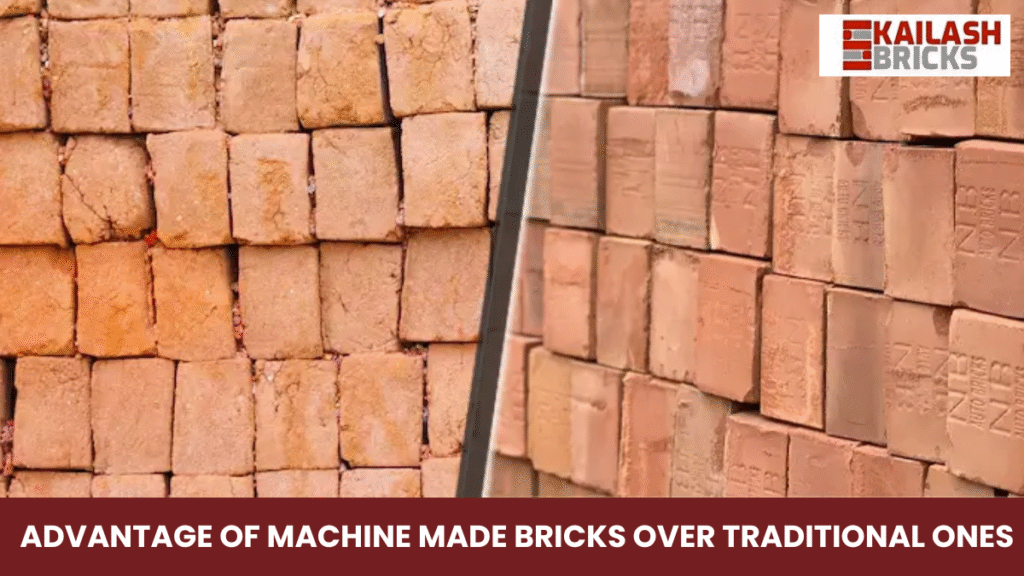
The construction industry has witnessed remarkable technological advancements in recent years, and one of the most notable transformations is the shift from traditional hand-molded bricks to machine-made bricks. While handmade bricks have long been a part of our architectural heritage, modern demands for precision, strength, and sustainability have encouraged builders to look for better alternatives. Machine-made bricks, like those produced by Kailash Bricks, represent the future of efficient and eco-friendly construction. Below, we explore the key advantages of machine-made bricks over traditional ones and how they are reshaping modern construction practices. 1. Superior Strength and Durability One of the most significant advantages of machine-made bricks is their exceptional strength. Traditional bricks are often made by manual molding and sun-drying, which leads to irregularities in shape and density. This inconsistency can weaken the structural integrity of buildings over time. Machine-made bricks, on the other hand, are manufactured using advanced hydraulic or mechanical presses that ensure uniform compaction and density. The result is a brick that can withstand greater loads and resist cracking or chipping. Builders using Kailash Bricks often highlight their long-lasting durability, which ensures that structures remain strong and stable for decades. 2. Uniform Size and Shape Precision is essential in modern construction, especially when it comes to alignment, plastering, and finishing. Traditional handmade bricks tend to vary in size and shape due to manual production methods, leading to uneven walls and increased mortar consumption. Machine-made bricks solve this problem through automated molding and pressing processes that maintain consistent dimensions for every brick produced. This uniformity not only enhances the aesthetic appeal of buildings but also significantly reduces plastering costs and construction time. Contractors who use Kailash Bricks machine-made products often experience smoother workflows and better finishing quality. 3. Enhanced Aesthetic Appeal Machine-made bricks offer a cleaner, smoother finish and a more appealing appearance compared to traditional handmade bricks. The surface texture can be customized to suit different architectural needs—whether you prefer a rustic look or a sleek, modern façade. Moreover, because these bricks are precisely shaped, they fit together neatly, producing walls that are visually consistent and professional-looking. Many modern developers choose Kailash Bricks because of their commitment to producing aesthetically refined and high-quality bricks that elevate the look of any construction project. 4. Greater Production Efficiency In today’s fast-paced construction environment, time efficiency is crucial. Traditional brickmaking is a labor-intensive and time-consuming process that relies heavily on manual labor and weather conditions. Sun-drying, for example, can take days, and production often slows down during the rainy season. Machine-made brick production is far more efficient and less dependent on environmental factors. Automated systems allow for continuous, large-scale production, ensuring a steady supply of uniform bricks throughout the year. Kailash Bricks utilizes advanced machinery and technology to meet large construction demands without compromising quality, helping developers meet deadlines with ease. 5. Environmentally Friendly Manufacturing Sustainability has become a core focus in modern construction, and machine-made bricks contribute significantly to eco-friendly building practices. Traditional brick kilns often burn coal or wood, releasing large amounts of carbon emissions and depleting natural resources. In contrast, many machine-made brick manufacturers, including Kailash Bricks, adopt energy-efficient production techniques that reduce pollution and minimize waste. These bricks can be made using fly ash or other industrial by-products, transforming waste materials into durable building components. As a result, they help lower the carbon footprint of construction projects and support sustainable development goals. 6. Reduced Water Absorption Water absorption is a key factor that determines the longevity and maintenance requirements of a building. Traditional bricks, because of their porous nature, tend to absorb more water, leading to issues such as dampness, efflorescence, and plaster peeling over time. Machine-made bricks are denser and less porous, meaning they absorb less water and provide better resistance to moisture-related problems. Builders who use Kailash Bricks machine-made products appreciate their ability to maintain structural integrity even in humid or rainy environments, reducing long-term maintenance costs. 7. Cost-Effectiveness Over Time While machine-made bricks might seem slightly more expensive initially compared to traditional handmade bricks, they offer substantial cost savings in the long run. The uniform size and shape reduce the amount of mortar required, and their smooth surface minimizes plastering needs. Furthermore, the durability of these bricks reduces repair and replacement costs over time. When you factor in faster construction and reduced wastage, Kailash Bricks machine-made options prove to be highly economical and value-driven for both residential and commercial projects. 8. Fire and Weather Resistance Machine-made bricks undergo a controlled firing process that ensures consistent hardness and strength. As a result, they offer superior fire resistance compared to traditional sun-dried or unevenly fired bricks. Additionally, these bricks can withstand extreme weather conditions—be it heavy rains, heat, or frost—without losing their structural properties. Many engineers and architects recommend Kailash Bricks because of their proven ability to perform well in diverse climatic conditions, ensuring safety and longevity for every structure. 9. Lower Rejection Rate and Quality Assurance Quality control is another area where machine-made bricks excel. The automated process ensures each brick meets strict dimensional and strength standards. In traditional methods, human error can cause inconsistencies, resulting in a high rejection rate. Manufacturers like Kailash Bricks conduct rigorous quality checks at every stage—from raw material selection to the final product—to maintain superior standards. This reliability ensures that builders get the exact quality they expect, batch after batch. 10. Meeting Modern Construction Standards As construction technology evolves, builders are expected to adhere to higher standards of precision, safety, and sustainability. Machine-made bricks are engineered to meet modern building codes and performance requirements. They offer greater load-bearing capacity, consistent texture, and energy efficiency—all qualities that align with contemporary construction needs. Kailash Bricks, as a leading name in the industry, continues to innovate and produce machine-made bricks that meet the demands of modern infrastructure while preserving the timeless strength of brick masonry. Conclusion The shift from traditional handmade bricks to machine-made bricks marks a major milestone in the construction industry. With their superior strength, uniformity, durability, and sustainability,

Advantages of Machine-Made Bricks Over Traditional Ones Read More »

Thermal insulation in perforated bricks by Kailash Bricks used in energy-efficient wall construction.

The Science Behind Thermal Insulation in Perforated Bricks

In modern construction, the demand for energy-efficient and environmentally sustainable building materials is higher than ever. One of the most innovative solutions in masonry is the perforated brick—a brick designed not just for structural integrity but also for superior thermal insulation. Unlike conventional solid bricks, perforated bricks have carefully designed holes or perforations that reduce their weight, improve heat resistance, and enhance overall building performance. This article explores the science behind thermal insulation in perforated bricks, examining their structure, materials, and benefits. We’ll also look at how leading manufacturers like Kailash Bricks are setting new benchmarks in sustainable construction. 1. Understanding Perforated Bricks Perforated bricks are clay bricks with cylindrical or rectangular holes that pass through their thickness. These perforations typically occupy about 25–60% of the brick’s volume. The primary purpose of these perforations is twofold: Manufacturers such as Kailash Bricks have refined this design to achieve the perfect balance between strength and insulation, ensuring that the bricks meet modern construction demands. 2. Thermal Conductivity and the Role of Air The effectiveness of perforated bricks lies in their ability to limit thermal conductivity. Thermal conductivity is the measure of a material’s ability to conduct heat. Solid clay has a higher thermal conductivity than air, meaning that it transfers heat more readily. By introducing perforations, the brick traps air pockets within its structure. Air has a very low thermal conductivity—around 0.024 W/mK, compared to fired clay’s 0.6–1.0 W/mK. These trapped air pockets slow down heat transfer through the wall, keeping interiors cooler in summer and warmer in winter. This natural insulation reduces the need for artificial cooling or heating, leading to significant energy savings over time. Kailash Bricks, known for their high-quality clay and precision manufacturing, optimize the size and distribution of perforations to maximize this insulating effect while maintaining structural strength. 3. Perforation Patterns and Their Impact Not all perforated bricks are the same. The pattern, shape, and distribution of holes have a direct impact on thermal insulation: Leading manufacturers like Kailash Bricks carefully design these perforations based on building requirements, ensuring that the brick’s geometry enhances thermal performance without compromising durability. 4. Material Composition and Firing Techniques Thermal insulation isn’t determined by perforations alone; the material composition and firing techniques also play a crucial role. High-quality clay with low impurities results in bricks with more consistent pore structures and better insulation. Additives such as fly ash or sawdust are sometimes included to create micro-pores, further improving insulation. Advanced kiln firing techniques, like those used by Kailash Bricks, ensure uniform firing temperatures. This results in bricks that are not only strong but also possess optimal porosity for thermal efficiency. Uniform porosity ensures that air pockets are evenly distributed, maximizing the insulating effect. 5. Energy Efficiency and Building Performance Buildings constructed with perforated bricks demonstrate remarkable energy efficiency. According to studies, walls made with perforated bricks can reduce heat transmission by up to 30–50% compared to solid brick walls. This reduced thermal bridging translates into lower HVAC loads, reduced electricity bills, and a more comfortable indoor climate. Builders and architects are increasingly choosing perforated bricks from trusted suppliers like Kailash Bricks, not just for their environmental benefits but also for their contribution to Green Building Rating Systems such as GRIHA and LEED. Using these bricks can help projects achieve higher sustainability scores and certifications. 6. Moisture Resistance and Breathability An often-overlooked advantage of perforated bricks is their breathability. The perforations allow for controlled vapor permeability, which helps maintain healthy indoor humidity levels. At the same time, modern perforated bricks are engineered to resist direct water penetration, preventing moisture build-up inside walls. Manufacturers like Kailash Bricks employ precise molding and finishing techniques to ensure that perforations do not become moisture traps. Their bricks are tested for both water absorption and vapor transmission, guaranteeing long-lasting performance even in humid climates. 7. Structural Performance and Weight Reduction Despite their perforations, these bricks maintain excellent structural strength when manufactured correctly. The reduced weight of perforated bricks—often 20–30% lighter than solid bricks—makes them easier to handle and transport. This leads to faster construction times and lower structural loads on foundations and supporting elements. Kailash Bricks uses state-of-the-art extrusion and firing methods to produce perforated bricks with consistent density and compressive strength. This ensures that they meet or exceed IS standards while offering superior insulation properties. 8. Environmental Impact and Sustainability The environmental benefits of perforated bricks are significant: With growing awareness of sustainable construction, Kailash Bricks has become a preferred choice among eco-conscious builders and architects. Their commitment to eco-friendly production methods—such as using cleaner fuels and efficient kilns—aligns with modern green building practices. 9. Practical Applications Perforated bricks are versatile and used in various applications: Many architects source perforated bricks from Kailash Bricks for both residential and commercial projects, appreciating their balance of performance, durability, and design flexibility. Conclusion The science behind thermal insulation in perforated bricks lies in their intelligent design, material composition, and manufacturing precision. By incorporating air pockets within their structure, these bricks drastically reduce heat transfer, contributing to energy-efficient, comfortable, and sustainable buildings. As the construction industry moves toward greener solutions, the role of high-quality perforated bricks becomes increasingly vital. Companies like Kailash Bricks are at the forefront of this innovation—producing bricks that not only meet structural and thermal requirements but also align with environmental goals. Whether you’re an architect designing modern energy-efficient spaces or a builder looking for reliable materials, perforated bricks offer a smart, sustainable solution for the future of construction.

The Science Behind Thermal Insulation in Perforated Bricks Read More »

How brick quality affect longevity and strength of a building

How Brick Quality Affects the Strength and Longevity of Your Building

When it comes to construction, brick quality is one of the most crucial factors that determine the strength, safety, and longevity of any building. From residential houses to commercial complexes, using poor-quality bricks can lead to early damage, high maintenance costs, and even structural failure. On the other hand, high-quality bricks ensure durability, energy efficiency, and long-term value. As a trusted brick manufacturer in India, Kailash Bricks has been helping builders and homeowners choose the right materials for strong and reliable construction. In this blog, we’ll explore how brick quality impacts your building and why it should never be compromised. 1. Strength and Load-Bearing Capacity Bricks form the foundation of your walls. High-quality bricks with proper compressive strength can easily bear heavy loads, ensuring structural stability. Poor-quality or under-burnt bricks, however, may crack under pressure, weakening the entire building.  At Kailash Bricks, every brick undergoes strict quality testing to ensure maximum strength and durability. 2. Resistance to Weather Conditions Buildings are exposed to extreme heat, rain, and cold throughout the year. Inferior bricks absorb moisture quickly, leading to dampness, wall seepage, and fungal growth. High-quality, well-burnt bricks have low water absorption, making your structure resistant to weather damage. 3. Longevity and Durability The life of a building largely depends on the quality of materials used. Using first-class bricks not only increases the lifespan of the structure but also reduces the need for frequent repairs. A house built with premium-quality bricks can last for generations without losing its strength. 4. Aesthetic Appeal and Finishing Good-quality bricks have a uniform size, shape, and colour, which makes the wall look smooth and appealing even without plastering. This not only enhances the aesthetic appeal of your building but also reduces finishing costs. 5. Energy Efficiency and Insulation High-quality bricks provide natural thermal insulation, keeping interiors cool in summer and warm in winter. This reduces energy consumption for air conditioning and heating, making your home more eco-friendly and cost-efficient. 6. Safety and Structural Integrity Buildings made with weak or poor-quality bricks are more prone to cracks, collapse, and other safety hazards. Choosing reliable, high-strength bricks ensures the safety of your family or employees. How to Identify Good-Quality Bricks? Before purchasing, here are a few quick checks: Why Choose Kailash Bricks? At Kailash Bricks, we believe that quality is the foundation of trust. Our machine-made bricks are: Whether you are building a small home or a large commercial project, Kailash Bricks provides the strength your structure deserves. The quality of bricks directly affects the strength, safety, and longevity of your building. Choosing premium, tested, and durable bricks ensures peace of mind and long-lasting construction. Don’t compromise on the foundation of your dream project — invest in quality bricks today.  Looking for the best quality bricks in Haryana? Contact Kailash Bricks today and build a stronger tomorrow.

How Brick Quality Affects the Strength and Longevity of Your Building Read More »

Thermal Hollow Roof Tiles By Kailash Bricks

Thermal Hollow Roof Tiles: Summer-Smart Roofing Solutions by Kailash Bricks

As Indian summers become increasingly harsh and energy costs rise, smart homebuilders and architects are turning to thermal hollow roof tiles — a game-changing solution for passive cooling and sustainable architecture. At Kailash Bricks, we specialise in manufacturing eco-friendly roof tiles that not only beautify your building but also insulate it naturally. If you’re planning a new home, commercial space, or even retrofitting your old roof, here’s why thermal hollow tiles from Kailash Bricks are the ultimate summer-smart solution. What Are Thermal Hollow Roof Tiles? Thermal hollow roof tiles are specially designed clay tiles with internal hollow cavities. These air-filled spaces act as insulation barriers, preventing heat from penetrating your home. The structure reduces thermal conductivity, making the roof cooler from inside even when exposed to extreme sunlight. Unlike traditional solid clay tiles or concrete slabs, hollow clay tiles trap air in their internal cavities. This passive insulation helps maintain lower indoor temperatures during summer without the need for constant air-conditioning. Benefits of Using Thermal Hollow Roof Tiles 1. Superior Heat Insulation Thanks to their hollow design, these tiles significantly reduce the transmission of heat through the roof. Studies show that hollow clay roof tiles can reduce indoor temperatures by 5–8°C, depending on local climate and construction style. 2. Energy Efficiency By reducing your dependence on fans, coolers, or AC units, Kailash thermal roof tiles lower your energy consumption. This directly translates into lower electricity bills and a reduced carbon footprint. 3. Eco-Friendly Roofing Our thermal tiles are made using natural clay, extruded with precision and fired in controlled kilns. They are 100% recyclable, durable, and free from harmful chemicals — a perfect fit for green building certifications like IGBC or GRIHA. 4. Load-Bearing and Durable Despite being hollow, these tiles are structurally strong and load-bearing, making them ideal for all types of buildings — residential, institutional, and commercial. 5. Aesthetic Appeal Kailash Bricks offers a variety of terracotta roof tiles, including Mangalore-style tiles, flat clay tiles, and designer hollow tiles that bring both rustic charm and modern minimalism to your rooftop.  Why Choose Kailash Bricks for Hollow Clay Roof Tiles?  ISO-Certified Manufacturing Our plant uses advanced extrusion technology to manufacture consistent, crack-free hollow tiles that meet international quality standards.  Weather-Resistant Finish Each tile is UV-resistant, waterproof, and fungus-resistant, ensuring long life even in monsoon or high-humidity zones like coastal regions.  Custom Sizes and Shapes Choose from a range of profiles, including flat thermal roof tiles, arched roof tiles, and half-round tiles. Customization ensures that our tiles fit your exact roofing design. Proven Track Record Kailash Bricks has supplied to over 5,000+ residential and commercial projects across Haryana, Delhi NCR, and Punjab. Our products are trusted by top architects and government agencies alike. How Thermal Hollow Tiles Work in Indian Summers Indian summers can push daytime temperatures above 45°C, especially in cities like Delhi, Jaipur, and Panipat. Traditional concrete roofs absorb and trap this heat, radiating it into the interiors even at night. In contrast, thermal hollow tiles: This makes them ideal for climate-responsive architecture in hot and dry zones. Ideal Use-Cases for Thermal Hollow Roof Tiles Installation Tips for Thermal Clay Tiles Kailash Bricks also offers on-site installation support and guidance, making the process seamless for builders and homeowners alike. Where to Buy Thermal Roof Tiles? You can visit our official website or call our sales team to place orders. We supply across Delhi NCR, Haryana, Punjab, Rajasthan, and also cater to bulk project orders nationwide. Thermal hollow roof tiles are more than just a roofing material — they are a smart investment in comfort, sustainability, and long-term cost savings. As one of India’s most trusted clay brick and tile manufacturers, Kailash Bricks is committed to offering roofing solutions that blend tradition, technology, and eco-consciousness. Upgrade your building today with heat-resistant roof tiles that not only look great but also work hard to keep you cool.

Thermal Hollow Roof Tiles: Summer-Smart Roofing Solutions by Kailash Bricks Read More »